

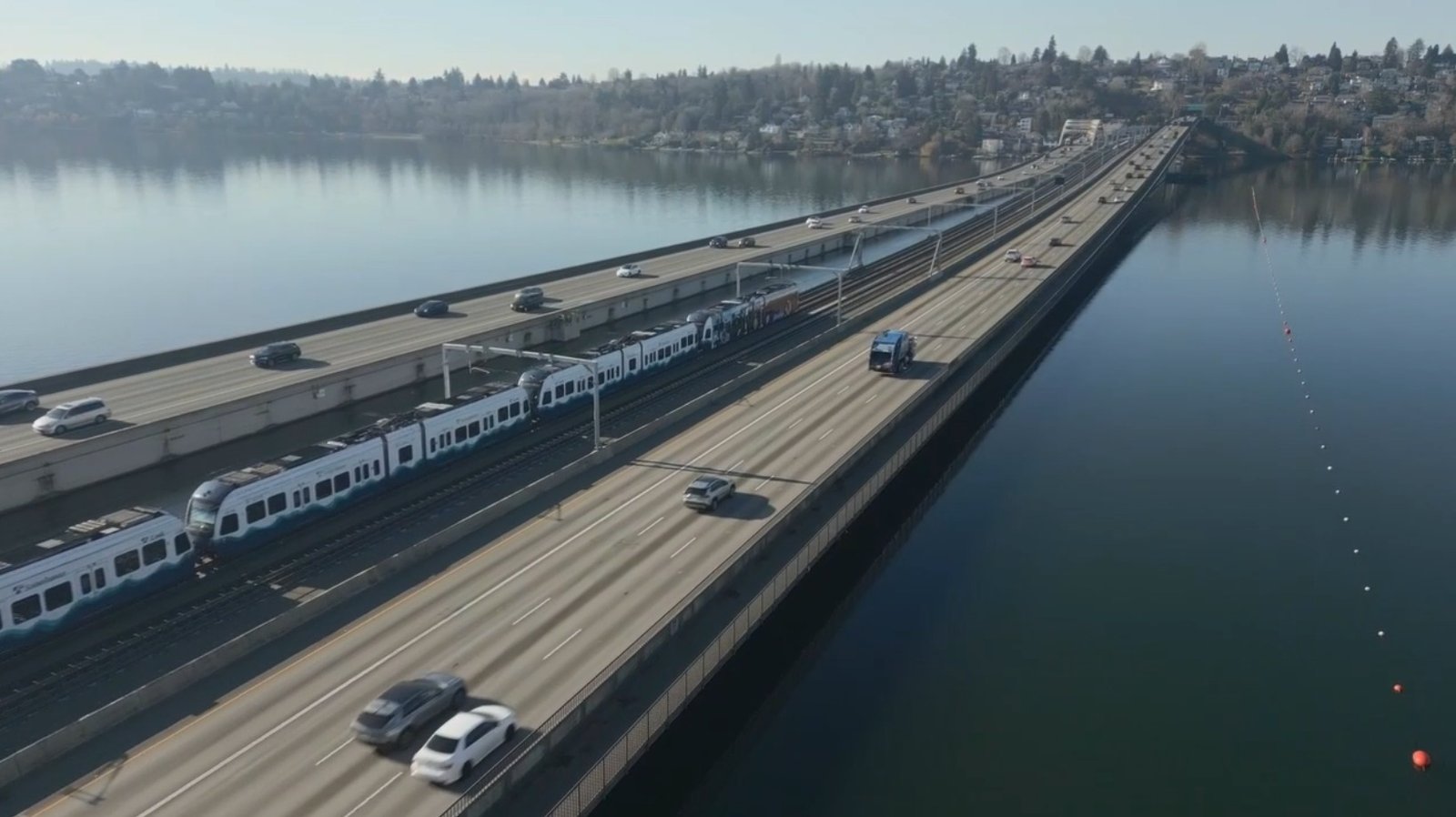
MERCER ISLAND, Wash. — After years of anticipation, light rail service has finally arrived on Mercer Island. The newly opened Crosslake Connection carried its first passengers across Lake Washington last week, marking a major milestone in the expansion of the Link 2 line. For the first time, riders can travel directly between Seattle and the Eastside by light rail, a development many commuters have been waiting on for years.
Among those eager to take advantage of the new service is Mercer Island resident Shannon Cruzen. She said the project has been a long time in the making. “It was originally expected to open around the time my daughter graduated a few years ago,” Cruzen recalled.
Now that the station is operational, Cruzen has incorporated the light rail into her daily routine. She commutes each weekday to her teaching job in Seattle’s Capitol Hill neighborhood and says the experience has been a noticeable improvement over driving. Instead of sitting in traffic, she can relax during the trip. “It’s been really nice to just sit back and not worry about congestion,” she said. “And honestly, it’s faster than I expected.”
Cruzen’s experience reflects the excitement shared by many residents who were looking forward to a more convenient and reliable way to travel across the lake. Local business owners have also been watching closely, hoping the increased connectivity will bring more visitors and boost activity in the area.
However, as the initial excitement settles, practical concerns about accessing the station are beginning to surface. City leaders say one of the most common questions they hear from residents is not about the train itself, but about how to get to it.
“That’s the number one thing people are asking—how do I actually use this system?” said Mercer Island Mayor Dave Rosenbaum.
The biggest challenge appears to be parking. The Mercer Island Park-and-Ride, located directly across from the station, offers 447 parking spaces. According to city officials, those spots tend to fill up quickly, often early in the morning, leaving late-arriving commuters scrambling to find alternatives.
Compounding the issue, most of the streets surrounding the station are restricted to permitted parking during weekday business hours, typically between 8 a.m. and 5 p.m. This limits options for commuters who might otherwise rely on nearby street parking.
Rosenbaum expressed concern that these limitations could discourage people from using the light rail altogether. “If someone is already running late and then can’t find a place to park, it adds a lot of stress,” he said. “Over time, that could lead people to lose confidence in the system, which is the opposite of what we want.”
In an effort to address the shortfall, the city developed a small additional commuter lot near the station late last year. The lot provides 36 extra spaces, though they are paid spots and represent only a modest increase compared to overall demand.
Even with that addition, city officials worry about unintended consequences. One concern is that commuters may begin parking in the Town Center area, where spaces are intended to support local businesses. If those spots are taken up by all-day parkers, it could reduce turnover and make it harder for customers to visit shops and restaurants.
“We want to make sure there’s enough availability for people coming in to support local businesses,” Rosenbaum said. “If commuter parking spills over into those areas, it could create challenges for our business community.”
As Mercer Island adjusts to its new role as a light rail stop, city leaders say they will continue monitoring how the system is used and what improvements may be needed. While the arrival of light rail is widely seen as a positive step toward better regional connectivity, ensuring that residents can easily access the service will be key to its long-term success.